English
 русский

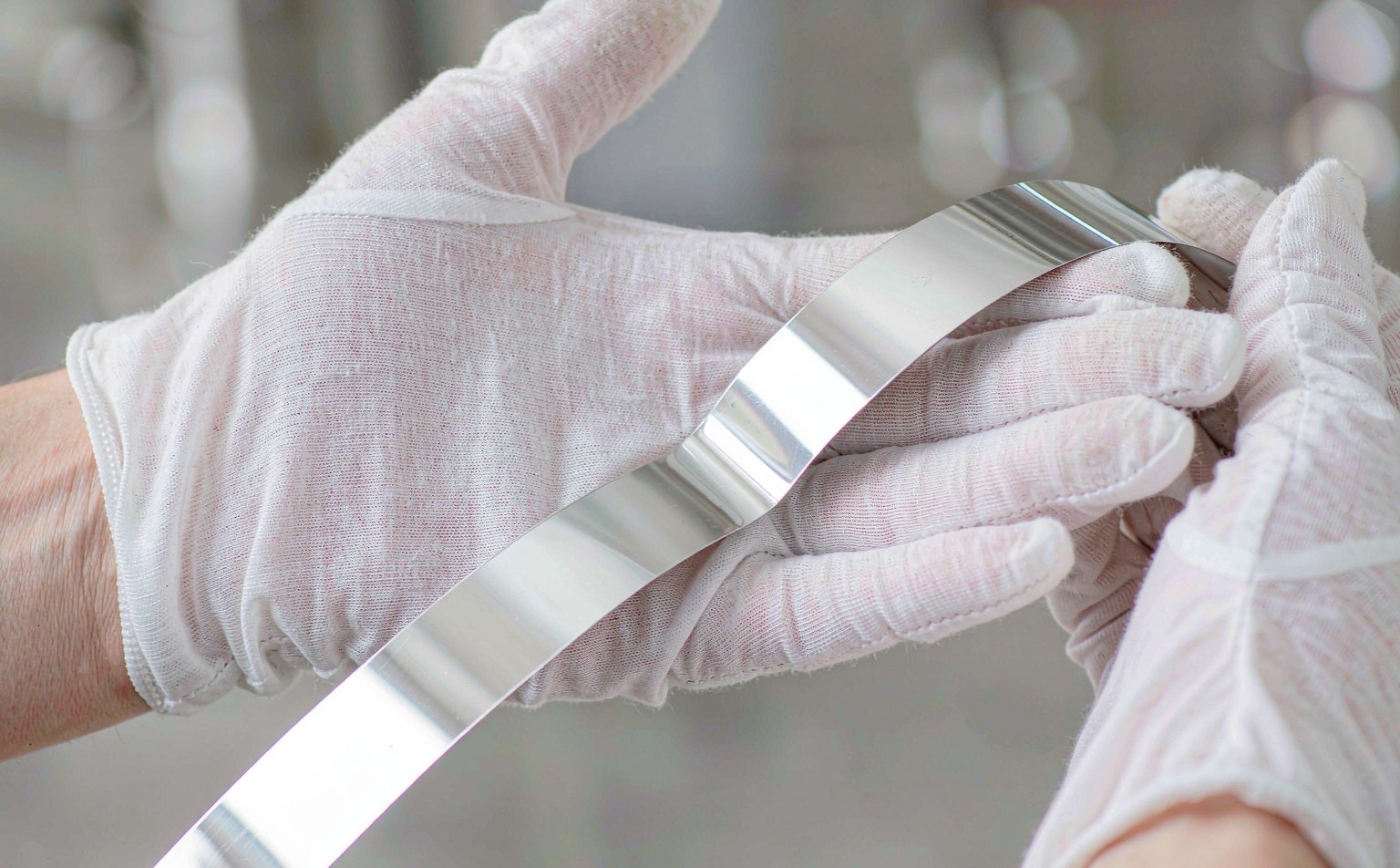
An ultra-thin stainless steel strip held between gloved hands, showing a mirror BA surface.
A slitting line recoiler winding narrow stainless strips with an operator checking the edge.
Appliance and electronics makers are pulling demand toward thinner gauges — 0.3–1.0 mm in appliance panels and heating tubes, 0.03–0.3 mm in 3C parts — and strip that holds a stable tolerance at those gauges is in structurally short supply. The bottleneck is not steelmaking. It is rolling, annealing and slitting discipline.
Which parts are pulling the gauge down
Gauge by application
|
Sector |
Gauge used |
Grades |
Parts |
|
Home appliance |
0.3 – 1.0 mm |
430, 304 |
Drums, panels, heating tubes, liners |
|
Automotive |
0.04 – 2.0 mm |
304, 301 |
Heat shields, gaskets, exhaust parts |
|
3C electronics |
0.03 – 0.3 mm |
304, 301, 316L |
Notebook parts, HDD, heat spreaders, battery covers |
|
Specialty |
0.01 – 3.0 mm |
301, 304, 316L, 430, FeCrAl |
Solar, button cells, needles, shavers, cooktops |
The reasons are physical, not fashionable. Thinner panels cut appliance weight and material cost. Thinner thermal shields fit tighter battery and exhaust packaging. Thinner battery covers and heat spreaders free up space in devices that cannot grow. Every one of these parts is stamped or drawn at speed, which is why gauge consistency matters more than the nominal gauge itself.
The four defects thin gauge amplifies
- Thickness drift — a 0.01 mm drift on a 0.05 mm strip passes silently through a stamping die and shows up as die wear and burrs on the part.
- Scratches — a mirror BA surface records every roller mark between annealing and packing.
- Burr — slitting edge quality at thin gauge decides whether downstream winding and stamping run clean.
- Camber — a strip that wanders off-line feeds badly into automated lines and multi-station dies.
Catching these four is an equipment and record question. At Ningbo Huali, a 23-roll tension leveler runs online surface inspection with defect alarm and a full-length defect record, so a coil ships with its own defect log. The in-house laboratory covers hardness (Vickers, Rockwell, Brinell), XRF chemistry, salt spray and tensile testing, and each shipment carries an EN 10204 3.1 mill test certificate traceable to the heat number.
What a workable thin-gauge commitment looks like
Thin gauge has to be a capacity statement, not a brochure word. At Ningbo Huali Steel, gauges of 0.10 mm and below account for 15% of a 42,000-tonne annual programme — 6,300 tonnes, not samples. Thickness tolerance is ±0.003 mm on 0.03–0.05 mm and ±0.006 mm on 0.10–0.25 mm; bright annealing runs to 0.02 mm; slitting reaches 15 mm width with controlled burr. Three questions separate suppliers who can do this from suppliers who say they can: which mill rolled the coil, which furnace annealed it, and which record follows it out of the gate.
What is the thinnest stainless steel strip available commercially?
Ningbo Huali Steel supplies 0.01 mm commercially, with bright annealing down to 0.02 mm; gauges of 0.10 mm and below make up 15% of its 42,000-tonne annual programme.
Why does thickness tolerance matter in stamping?
A 0.01 mm drift on thin strip changes blanking clearance silently, producing die wear, burrs and part rejection before the operator sees a signal.
What is a BA surface finish?
Bright annealed: the strip is annealed in a protective atmosphere, so the surface leaves the furnace oxide-free and reflective without further polishing.